Friday, May 22, 2015

TESOL Day #2 - A long overdue Recap


TESOL Convention - Toronto - Friday, March 27, 2015

Here are highlights from the four sessions I attended on the second day of TESOL.


Transitioning to College Writing: Language Use and Sentence Level Skills

This workshop involved a series of presenters, all who focused on the issue of supporting students' linguistics needs as they develop as college writers.

Ditlev Larson from Winona State University used the experiences of three students (from his larger study of freshman L2 writers) to highlight the gap between the way language issues are addressed in high school writing classes and the language expectations in college. All three students stressed that they felt unprepared to meet the new and more sophisticated linguistic demands of their college classes. Larson suggested that the concern over "deficit thinking" in high school and even college writing classes has led many teachers to avoid focusing on sentence-level issues, but he asked, "Are we doing students a disservice by not focusing at all on sentence-level issues? If the expectation is there, where and when should it be taught?"

Dana Ferris discussed how her institution, University of California-Davis, has begun to incorporate language development into their FYC (first year composition) program.  Ferris began with the challenges the FYC program faced--an extremely diverse student population, a teaching staff not trained in ESL, a packed syllabus, and a broad range of student needs.  Ferris and her colleagues wondered, "How can we have a more integrated, organized approach to language?"  The answer was adding "guided self-study" to the curriculum.  Students could pursue one of three options:  Self-Directed Vocabulary Journal, Grammar-Mechanics Self-Study, or Style Analysis Journal.  The materials for each of these options were provided (and didn't have to be developed by the teachers) and the students did the work outside of class.  Ferris discussed how this Language Development Program (LDP) has evolved over the last three years and she also shared student feedback.

Wednesday, May 6, 2015

Best Practices for Community Colleges and US-LM Students - Part One

Kibler, Amanda K., George C. Bunch, and Ann K. Endris.  “Community College Practices for U.S-Educated Language-Minority Students: A Resource-Oriented Framework.”  Bilingual Research Journal 34.2 (2011): 201-222.

Brief  Summary


In this article, Kibler et al. call for community colleges to rethink the way they work with US-educated linguistic minority students—moving from a deficit model to a resource approach that builds on the language and literacy knowledge students already have and focuses on integration versus separation, “creating the kinds of opportunities that students need to further expand their academic language and literacy repertoires, acknowledging that these repertoires are developed in the authentic contexts in which they are used” (205).  They outline four areas that colleges need to address in order to create a “resource-oriented” framework:
  • Supporting academic transitions into community colleges.
  • Integrating language and academic content.
  • Providing accelerated access to college-level, mainstream academic curriculum.
  • Promoting informed student decision-making.
  • (206)
Kibler et al. discuss the principles behind addressing each of these areas from a “resource” perspective and give examples of innovative ways community colleges could and do attempt to tackle these issues in order to more effectively meet the needs of US LM students. 


Friday, May 1, 2015

Myth Busters Round 2 - Vocabulary Edition

Overview

Read this book!
In Vocabulary Myths-Applying Second Language Research to Classroom Teaching, Keith Folse debunks a series of myths that many L2 teachers hold about vocabulary—myths he believes “can be detrimental to our teaching effectiveness, and all of them can certainly hinder our students’ second language vocabulary learning” (160).  These myths include the following eight ideas:
  1. In learning another language, vocabulary is not as important as grammar or other areas.
  2. Using word lists to learn second language vocabulary is unproductive.
  3. Presenting new vocabulary in semantic sets facilitates learning.
  4. The use of translations to learn new vocabulary should be discouraged.
  5. Guessing words from context is an excellent strategy for learning second language vocabulary.
  6. The best vocabulary learners make use of one or two really good specific vocabulary learning strategies.
  7. The best dictionary for second language learners is a monolingual dictionary.
  8. Teachers, textbooks, and curricula cover second language vocabulary adequately.
Folse focuses a chapter on each of these myths and structures his discussion somewhat similarly for each chapter.

Monday, March 30, 2015

TESOL - Day #1

Thursday, March 26, 2015

One of the best things about TESOL this year was the TESOL app that I put on both my phone and iPad.  I was able to look through and mark sessions I was interested in for all three days before I even left Waukegan.  However, the downside was that when I looked at my agenda (a calendar with all the sessions you picked mapped out), I quickly saw that during some periods there were at least four or five things I was interested in AT THE SAME TIME.  Sigh.

However, I made my choices for Thursday before I started the day:
  • Helping Adult ELs Meet Language Demands of College and Careers
  • From Theory to Practice in SLW: Crossing Borders, Building Bridges
  • Strategies for Countering Discourses of Deficit in L2 Writing
All three of these sessions were the longer workshop format so they were all 105 minutes long versus 45 minutes and that seemed to allow for more information and more time for questions at the end.  Here's a recap of these three sessions.

Helping Adult ELs Meet Language Demands of College and Careers

Though the primary audience for this session was ESL instructors who work with students in adult education and immigrant programs, the information and ideas could easily be scaled up to any developmental English or ELI course because the vocabulary gap exists for many CLC students as they transition into college courses.

Benefits of One-Question Interview Activity
 Each of the three presenters tackled a different level of learner and presented an activity that would help to develop students' language repertoires and move them toward more academic/professional language skills.  Patsy Vinogradov discussed how a volunteer program at a church thrift store, the Alley Shoppe, helped her beginning, low-level-literacy students develop vocabulary and grammar related to sorting and displaying clothes as well as other workplace skills.   Betsy Parrish shared an activity, the one question interview, that asked intermediate level students to collect data about their classmates and both analyze the data and share their findings in writing.  Finally, Susan Finn Miller talked about the importance for upper-level students to learn Tier 2 vocabulary (abstract but not super content specific) and introduced us to the idea of the "Vocabulary Workout."


This was a great session with lots of handouts and interaction.  Not only did each presenter have us do a thinking/talking/writing task connected to each vocabulary activity but they gave us a chart at the beginning that asked us to consider three questions related to each of the activities presented:

  1. What is the academic language in the activities?
  2. What are other transitions/college and career readiness present in the activities?
  3. What could you do to adapt this to your context?

I found myself really excited about both the Vocabulary Workout concept and the "Collecting Classroom Data" activity and have already started to think about how to incorporate these into my English 109 class this fall.


From Theory to Practice in SLW: Crossing Borders, Building Bridges

This workshop had a lot of presenters including Dana Ferris (who I've been reading a lot of) and John Swales, who is a pretty famous linguist known for his work in genre analysis.  Each of the presenters made connections between research in Second Language Writing (SLW) and the classroom.  For example, Gena Bennett gave an overview of corpus-based research (corpora are giant databases of real textual samples that can be analyzed in all sorts of ways) and how they can relate to the teaching of academic writing.  Chris Freak discussed what qualities make an effective EAP (English for Academic Purposes) writing course.  John Swales discussed some research he did on citation using a set of 800 upper-level biology papers that had earned an A or B.

Add caption
My two favorite sessions out of this larger workshop both involved presenters I would see again during the conference.  Maria Estela Brisk, who works on using SFL (or Systemic Functional Linguistics) with elementary school ELs, described what a genre-based pedagogy would look like in early grades and the importance of teaching students both the language and the metalanguage they need to know to write different types of texts.

Dana Ferris,  not surprisingly, talked about "Connecting Error Analysis and Error Feedback for L2 Writing" and discussed the classroom implications of what she learned from two major research projects--research that has also generated much of the content of her recent books.  She did a nice job of showing the connection between what her research suggested and classroom principles:

  • Research showed that "teacher variables" matter so teachers need to be "prepared and principled."
  • Research showed that "learner variables" matter so teachers need to assess their students.
  • Research showed that "error types" matter so teachers need to learn about these types.
  • Research showed that "the mere presence of feedback" matters so "teachers should provide feedback rich environments."

Overall, I found this workshop gave me a good sense of how SLW research can be connected back to the classroom and I'm especially excited in learning more from Ferris and Brisk.

Strategies for Countering Discourses of Deficit in L2 Writing


This session also had a number of presenters (including Dana Ferris again) but focused on the important task of both identifying "deficit thinking" in relation to second language writers and also developing ways to combat that thinking.

Deficit thinking was defined by the presenters as "a rhetorical construction of students in terms of what they lack or are deficient in" and these constructions "ground decisions in the teaching, assessing, and administering courses for second language writers."

Christine Tardy discussed some of the forms these discourses take but also suggested strategies to combat them. For example, she mentioned how a "discourse of Essentialization" is used to lump students together--as ESL, as a certain nationality, as a visa designation.  One strategy to use against this is for teachers to get to know their students and to explore their diversity as well as notice the connections.  Another dynamic that Tardy pointed out was second language writers being framed as a "problem" that needs to be solved or dealt with.  She suggested that it would be better to see the institutional structures as a problem as well as to reframe students' multilingualism as a powerful resources.

Dana Ferris and Grant Eckstein outlined how deficit models can shape the classroom in terms of text selections, writing assignments, language instruction, and feedback approaches.  They then had us work in pairs to tackle one of three "deficit perspective" quotes and discuss both what problems we saw in the perspective as well as what a better approach might look like.  Finally, other topics discussed by the presenters included how deficit discourse can influence assessment as well as program structures and policies.

This was another strong session that gave me a lot to think about and had a lot of connections to what I do at CLC.
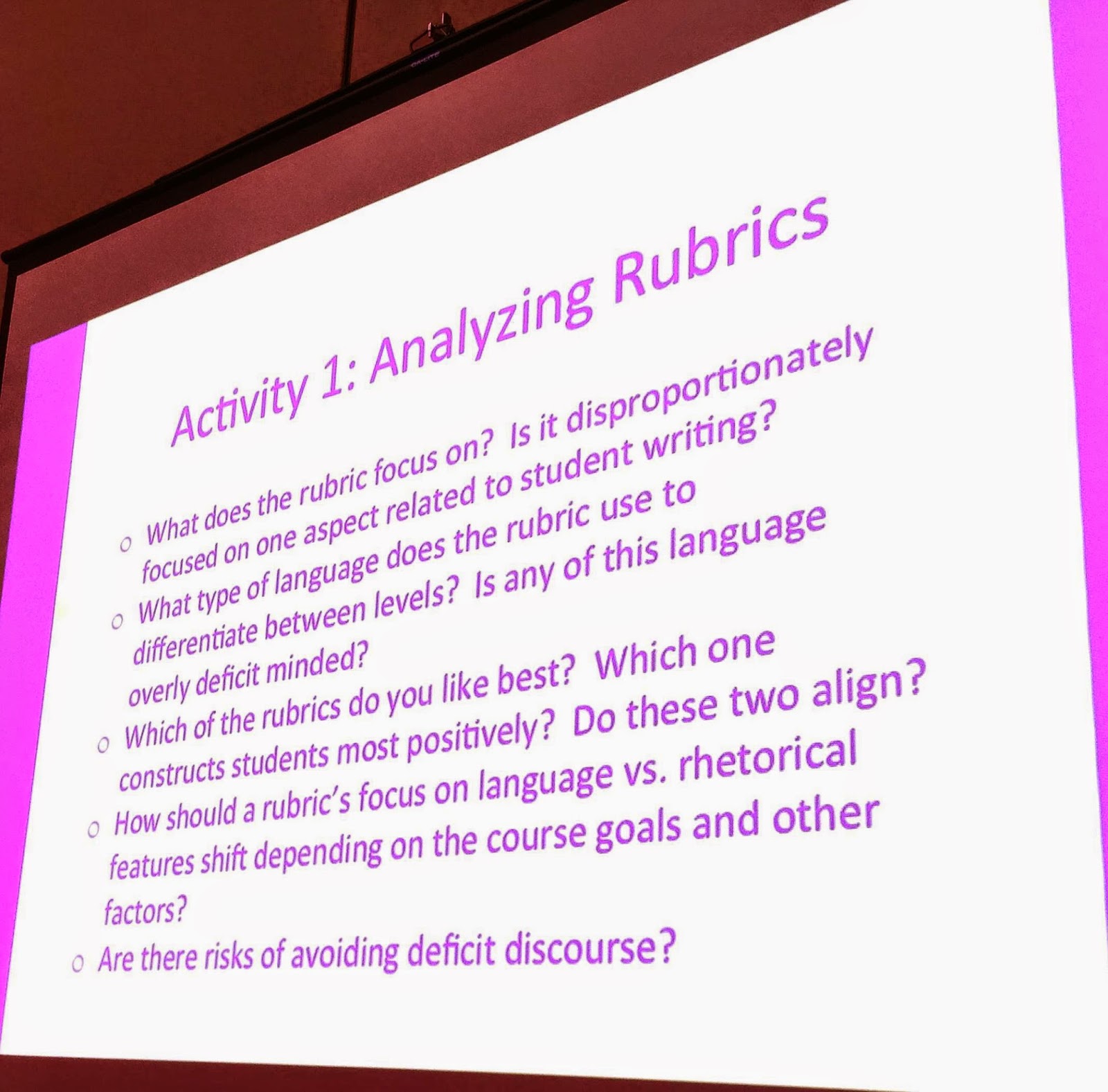
Deficit Thinking and Assessment


Friday, March 20, 2015

Far More Than a Lonely Cactus


Read this!

Leki, Ilona.  Undergraduates in a Second Language: Challenges and Complexities of Academic Literacy Development.  New York City: Lawrence Erlbaum, 2007.

The title of this post came from a phrase that Ilona Leki borrows from another scholar (Atkinson, 1999) to discuss how a language learner was once seen as “lonely cactus” but now the view is much more complex.  Exploring that complexity is exactly what Leki is after in Undergraduates in a Second Language as she describes the results and implications of a longitudinal ethnographic study she conducted with four multilingual students.  This book not only gives the reader some helpful insights into how four learners negotiated their undergraduate educations, but what Leki learned about their experiences has some important implications for both first-year writing programs and Writing Across the Curriculum (WAC) efforts. 

Thursday, March 19, 2015

Myth Busters – Second Language Writing Edition

Read this!!!
Reid, Joy, Ed.  Writing Myths: Applying Second Language Research to Classroom Teaching.  Ann Arbor: University of Michigan Press, 2008.  Print.

Overview

            In this collection of articles edited by Joy Reid, each author tackles a myth related to teaching writing, especially teaching writing to multilingual (or L2) students. The myths deconstructed in this book are the following:
  • Myth 1 - Teaching vocabulary is not the writing teacher’s job.
  • Myth 2 – Teaching citation is someone else’s job
  • Myth 3 – Where grammar is concerned, one size fits all.
  • Myth 4 – Make your academic writing assertive and certain.
  • Myth 5 – Students must learn to correct all their writing errors.
  • Myth 6 – Corpus-based research is too complicated to be useful for writing teachers.
  • Myth 7 – Academic writing courses should focus on paragraph and essay development.
  • Myth 8 – International and US resident ESL writers cannot be taught in the same class.
  • Myth 9 – Students’ myths about academic writing and teaching
Each chapter, except the last, is organized into three parts.  The first section, entitled “In the Real World,” is where the authors introduce the myth and explain or illustrate the problems with it.  Then, in “What the Research Says and Shows,” the authors discuss empirical research that supports why the myth is a myth.  Finally, in the last section, “What We Can Do,” the authors give concrete, practical advice about how to work with the issue in the classroom.

            Here’s one example of how a chapter plays out. In Chapter One, Keith Folse addresses the myth that writing teachers shouldn’t have to teach vocabulary.  He begins with describing his own students’ struggles with researched writing and suggests that this often is more related to vocabulary than to issues of plagiarism (intended or unintended).  He then brings in research to show how vocabulary “plays a critical role in successful writing” (4) including both studies that look at what qualities of an essay influence how a rater assesses it as well as what qualities are emphasized on grading rubrics.  He then offers eight suggestions for teachers to consider as they attempt to integrate vocabulary teaching into their classroom.

Brief response

            There are so many things I found helpful about this anthology.  The first was that each article was so clearly organized. Though I don’t think a lockstep approach like this works for every scholarly anthology, it makes sense here.  We’re introduced to the myth and the problems with it, we’re presented with an overview of the research, and then the author or authors gives us a list of suggestions and/or things to think about. 
            The second thing that stood out to me was how concrete yet flexible the suggestions in each chapter were.   Though the main audience for this text is teachers in L2 writing classrooms, many of the ideas apply to any teacher who teaches writing to a diverse student population.  I found myself writing notes about how the ideas presented might apply to my classroom, my writing center, and/or my institution.
            Personally, I found every chapter helpful but if my colleagues in the English department could only read a couple chapters, I would point them to these:
  • Pat Byrd and John Bunting’s argument against a one size fits all approach to grammar (Myth #3);
  • Dana Ferris’s take down of the idea that students should write error-free prose (Myth #5); and
  • Joy Reid’s discussion of the myths that students have about academic writing (and how teachers contribute to them) (Myth #9)
As soon as I picked these three, I thought, “But what about the chapter on vocabulary or the one about citation or the one on using hedges in academic writing?”  So, really, I think anyone who teaches writing could benefit from reading this whole darn book.  And, when you’re done, I want to talk with you about it.

Monday, March 9, 2015

Teachers Need to Learn What They May Have Acquired

Insight #3 from reading Dana Ferris's Treatment of Error in Second Language Student Writing:

One of my favorite moments in the Ferris book is when she says this:
Being a fairly competent user of the English language does not in and of itself prepare teachers to diagnose and respond to student error and to explain grammatical concepts in English (48).
Her words made me do a happy dance around my office and then made me realize that this sentence applies to me also. Just because I researched lots of grammar constructions in my IEP (Intensive English Program) teaching days doesn’t mean I don’t have work to do now. 

So, basically what Ferris is saying is that if teachers really want to help their multilingual students improve language-wise, they will have to hit the books to learn consciously some of the language knowledge that they acquired unconsciously (see my first blog post where I talk about the difference between acquisition and learning).